Visualizzazione post con etichetta David Gallagher. Mostra tutti i post

martedì 12 marzo 2024

R: GNOLL GOSSIP: AA OH6 DOGMEN AGAIN /GOSSIP GNOLL: ANCORA UOMINI CANE AA OH6


    Unfortunately February was a less than productive month for the hobby, but I am able to present some further information on the dogmen of Alternative Armies about which I had written a post some time ago and which are part of my project, never abandoned, of a warband of Nuthgnawers.
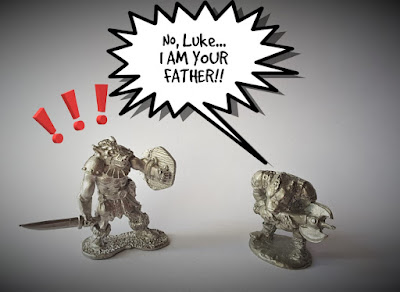
    I would like to open with another photoshop made by D, where the Gnoll TV News updates us on the latest rumours (if you missed the first photomontage, you can catch up on it here). Notice the kind of food one of the interviewees is holding...


"Dog eat (hot) dog"!


   To recap, I had ascertained that the four older dogmen of Alternative Armies (OH6) are the revival of miniatures from the 1980s sculpted by David Gallagher for the Rieder Design company, in a range called "Dungeon Dwellers", alongside several sets of goblins.
    However, I have now managed to get an AA flyer advertising those miniatures. Because of the uncoated paper (coated paper was instead used for later leaflets) and the handmade method of writing the codes of the miniatures in pen, I would believe that it can be dated to 1990 at the latest, before AA commissioned new sets of fantasy miniatures, such as the dogmen sculpted by Phil Lewis dating back to 1991.


    Each set is complemented by an introductory paragraph, which appears as a quotation taken from a larger written text (treatise, letter, encyclopedia and so on), sometimes including the name of its pretended author. I wouldn't be able to track down the model for such a device in fantasy publications - the closest example I've found are the WFRP second edition manuals, although they're much later.
    All the sets on this side of the flyer, which previously belonged to Rieder Design, are classified as "Un-men", and those who are here called "dog soldiers" are placed alongside orcs, breed-orcs, goblins, hob-goblins,  greater goblins.


    The flyer pretends that the introductory text dedicated to the "dog soldiers" is from "The Encyclopedia of Maas" under the heading "Homo Hyenus" (which was the original name of  the Rieder set). There is a double version of the origin of these strange creatures.
    The first is in turn attributed to "Catayan manuscripts", which seems to clearly refer to East Asia, already transposed into the "Cathay" of the D&D or Warhammer universe. According to the fictitious source, a dog-demon named Muchredipeeg bred the first specimens after stealing the "hareim" (?) of Prince Mikdan from the palace of Hiu-Sha. The sentence is not very clear, and perhaps it could be interpreted with the fact that the demon kidnapped the women of a "harem", with whom he then mated, giving birth to monstrous hybrids. The onomastic is generically oriental, but seems to mix a Chinese name of the palace with the Turkish name of the prince. The demon in animal form is most likely inspired by Yeenoghu, the D&D hyena god who created the gnolls (the invention and evolution of the character can be found here). The name of the AA demon, however, is not oriental at all, and I suspect it may hide a wordplay.


The lanky Yeenoghu by David Sutherland III


    The second version on the birth of dogmen reported by the fake entry of the encyclopedia is inspired by scientific thought, and goes back to comparing the creatures to goblins, making them a sort of goblins who (temporarily or permanently) changed their appearance. The same dogman-goblin kinship is then found in the different text that appears on the page of the AA website dedicated the OH6 set.
    The analysis of this minimal fragment of the vintage lore associated with miniatures is a further proof of the uncertainty with which the gnolls/dogmen have been classified over time in the various fantasy universes: hybrids between gnome and troll, between hyena and troll, between man and (demon-)dog, mutated hyenas, mutated goblins... This perhaps depends on the fact that such creatures did not find a direct precedent in folklore or had not appeared in organic narratives of classic fantasy, before popping up in the Seventies in the D&D manual, on the only nominal basis of the short stories by Dunsany and St. Clair (however both very vague about their physical appearance). 
    Before concluding the little column of curiosities, I would like to show another member of the Nuthgnawers that I have managed to get my hands on in the meantime: the gnoll Citadel ADD55 with guisarme. Only one with a polearm is missing to conclude the entire range!
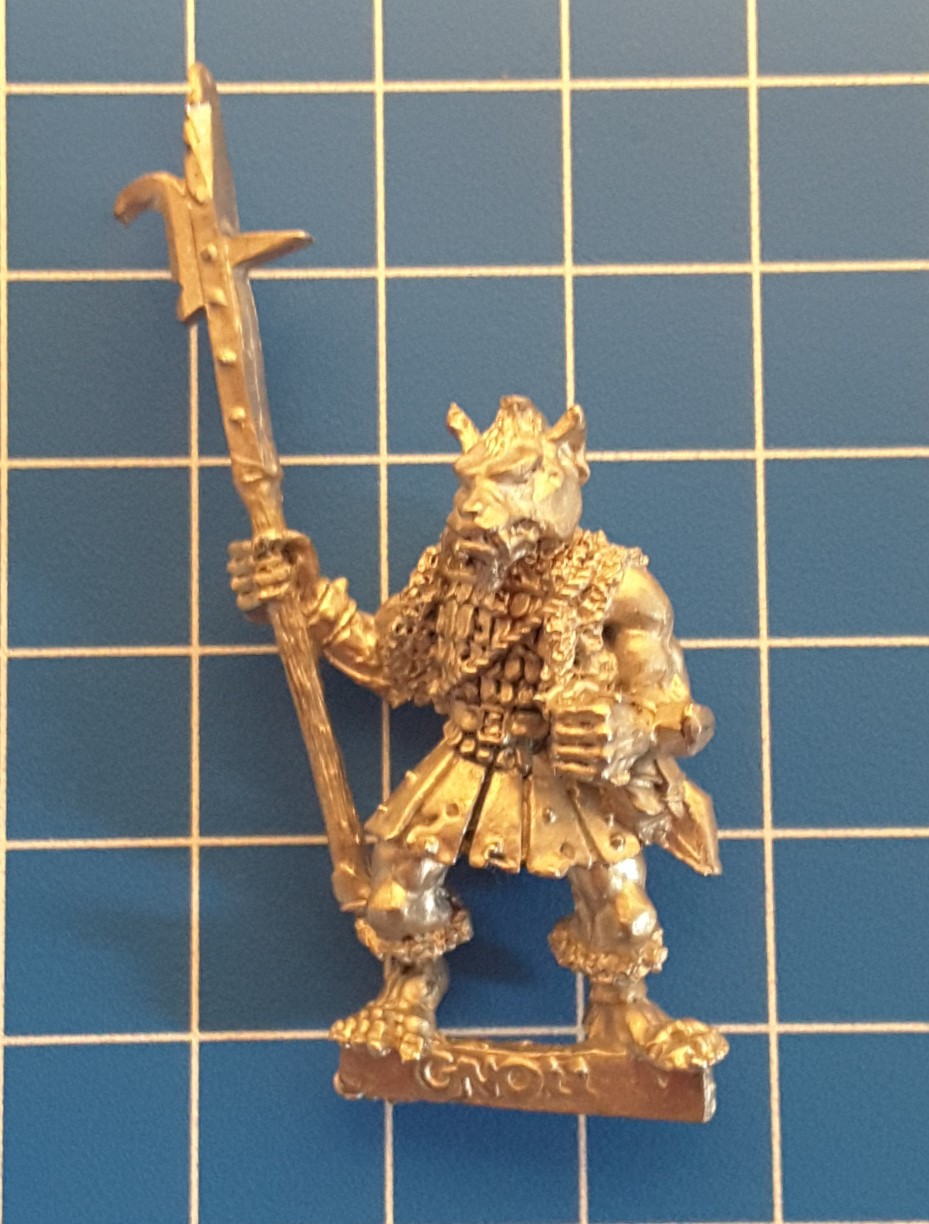

Here I am! Woof!


_______________________________________________________________________

    Febbraio è stato sfortunatamente un mese tutt'altro che produttivo per l'hobby, ma sono comunque in grado di presentare qualche ulteriore notizia sugli uomini cane di Alternative Armies riguardo ai quali avevo scritto un post tempo addietro e che rientrano nel mio progetto, mai abbandonato, di una banda di Nuthgnawers.
    Vorrei aprire con un altro fotomontaggio creato da D, dove il TG gnoll ci ragguaglia sulle ultime novità (se vi siete persi il primo fotomontaggio, lo potete recuperare qui). Notate il tipo di cibo che ha in mano uno degli intervistati...


"Cane mangia (hot) dog"!


    Per riepilogare, avevo appurato che i quattro uomini cane più vecchi di Alternative Armies (OH6) sono la riproposizione di miniature degli anni Ottanta scolpite da David Gallagher per la ditta Rieder Design, in una serie chiamata "Dungeon Dwellers", accanto a vari set di goblin.
    Sono però riuscito adesso a procurarmi un volantino di AA che pubblicizzava queste  miniature. In base alla carta non patinata ( la carta patinata venne invece usata per altri volantini posteriori) e al metodo artigianale di scrivere i codici delle miniature a penna, riterrei che possa datarsi al 1990 al più tardi, prima che AA commissionasse nuovi set di miniature fantasy, come gli uomini cane scolpiti da Phil Lewis che risalgono al 1991.


    Ogni set è accompagnato da un testo introduttivo, che si presenta come un passo tratto da un testo scritto più ampio (trattat, lettera, enciclopedia e così via), talora comprensivo del nome del suo supposto autore. Non sarei in grado di rintracciare il modello di questo espediente: l'esempio più simile che ho trovato sono i manuali della seconda edizione di WFRP, sebbene siano molto più tardi.
    Tutti i set di questa facciata del volantino, che in prescedenza appartenenvano a Rieder Design, sono fatti rientrare nella categoria dei "Non uomini", e quelli che sono qui chgiamati "soldati cane" sono affiancati a orchi, mezzorchi, goblin, hobgoblin, goblin maggiori.


    In particolare, il volantino vorrebbe che il testo introduttivo dedicato ai "soldati cane" fosse estratto da "L'enciclopedia di Maas" alla voce "Homo Hyenus" (che era la denominazione originaria del set Rieder). Dell'origine di queste strane creature è riportata una doppia versione. 
    La prima è attribuita a sua volta a dei "manoscritti Catayani" , che sembra rimandare all'oriente asiatico, già trasposto nel "Cathay " dell'universo D&D o Warhammer. Secondo la fonte fittizia un demone-cane di nome Muchredipeeg avrebbe creato le prime creature dopo aver rubato un "hareim" (?) del principe Mikdan dal palazzo di Hiu-Sha. La frase non è  molto chiara, e forse si potrebbe interpretare con il fatto che il demone abbia rapito le donne di un "harem", con le quali si è poi accoppiato producendo mostruosi ibridi. L'onomastica è genericamente orientale, ma sembra mescolare il nome cinese del palazzo con il nome turco del principe. Il demone in forma animale è molto probabilmente ispirato a Yeenoghu, il demone-iena di D&D creatore degli gnolls (l'invenzione e l'evoluzione del personaggio si può trovare qui). Il nome del demone di AA non è invece per nulla orientale, e sospetterei possa nascondere un gioco di parole.


Lo Yeenoghu dinoccolato di David Sutherland III 


    La seconda versione sulla nascita degli uomini cane riportata dalla finta voce dell'enciclopedia si ispira al pensiero scientifico, e torna ad apparentare le creature ai goblin, facendo di essi una sorta di goblin che (temporaneamente o definitivamente) hanno mutato il loro aspetto. La medesima parentela uomini cane-goblin si ritrova poi nel testo diverso che compare nella pagina del sito di AA dedicata al set OH6.
    L'analisi di questo minimo frammento della narrazione vintage associata a miniature costituisce un'ulteriore prova dell'incertezza con cui gli gnoll/uomini cane sono stati nel tempo classificati nei vari universi fantasy: ibridi tra gnomo e troll, tra iena e troll, tra uomo e (demone-)cane, iene mutate, goblin mutati... Ciò dipende forse dal fatto che tali creature non trovassero un precedente diretto nel folklore o non fossero comparse in narrazioni  organiche del fantasy classico, prima di saltar fuori negli anni Settanta nel manuale di D&D, sullo spunto solo nominale dei racconti brevi di Dunsany e St. Clair (comunque entrambi molto vaghi sull'aspetto fisico di esse).
    Prima di concludere la piccola rubica delle curiosità, vorrei mostrare un ulteriore membro dei Nuthgnawers su cui sono riuscito nel frattempo a mettere le mani: lo gnoll Citadel ADD55 con guisarme. Ne manca solo uno con arma in asta per concludere tutta la gamma!


Eccomi presente! Bau!


venerdì 22 luglio 2022

R: DOWN, DOWN TO THE GNOLL LIAR (2): DAVID GALLAGHER'S “HOMUS HYENUS” / GIU', GIU' NELLA TANA DEGLI GNOLL (2): LO “HOMUS HYENUS” DI DAVID GALLAGHER

Recap of the previous episode


   The amazing detective is looking for the date of production and the name of the sculptor(s) of two sets of Alternative Armies dogmen. For the OH16 set he has a brilliant intuition: to turn the miniatures upside down and to look the bottom of the base. In fact, he easily finds an inscription that confirms how they were sculpted in 1991 by Phil Lewis.
   However, our hero is faced with an insoluble dilemma: despite the difference in style and size, these miniatures would be almost contemporary to those of the other set (OH6), dating back to 1990 according to the information written to him by the manufacturer. A disturbing revelation, however, heralds that things are different than they seem ...


Dungeon Dwellers


   Excited by the discovery, I decided to repeat the experiment: I turned the miniatures of dogmen from OH6 set and ... nothing, there is no inscription engraved under the base! I then went to look where few would have had the idea to look for ... "Lost Minis Wiki". 
   Here at last the riddle had its solution. The four miniatures are in fact indicated as previously belonging to the "Dungeon Dwellers" range of Rieder Design, an English manufacturer of jewelry and fantasy-themed miniatures in the 1980s, some of whose moulds later passed to AA. 
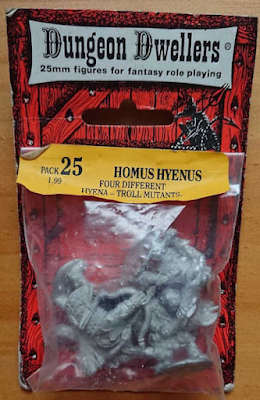
   Pack 25, shown in the photo below, had a really bizarre wording: "Homus Hyenus - Four different hyena-troll mutants" and contained the miniatures that would later become AA's "Dogmen Warriors".


   Here is the reason for the 'undersized' stature of the miniatures and the 'old style' in which they are made! 
   We first have confirmation that they are designed for a 25mm scale, as specified in the label; these specimens of "homus hyenus", with their 28 mm from the feet to the top of the head, would therefore have been found to be taller than a human on that scale. 
   Their kinship with the hyenas also ascertained that the source of inspiration are the gnolls of AD&D from 1977 onwards, albeit with a strange cross between hyenas, mutants and trolls that does not seem to have a foundation elsewhere. Perhaps this reflects a distant reminiscence of the mix between gnomes and trolls that was presented in 1974 by D&D (see the post on the prehistory of gnolls). A quirk, this, which would somehow be perpetuated in the Latin indication of "canum cobalorum" with which AA then designated these miniatures, transforming them into a cross between goblins and beastmen. 
   (Pedantic note: it seems, by the way, that in those years the pseudo-Latin was fashionable in the British fantasy, where an ending in -us or in -um was enough and everything acquired another charm...)


David Gallagher's "Homus hyenus"


   As can be seen from the following images, the Rieder Design ad (from "Dragon Magazine", 129, 1988, pp. 44-45) specified that the "Dungeon Dwellers" range was sculpted by a "Dave Gallagher".


   Given the homonymy with the David Gallagher that all Warhammer lovers know as an illustrator, we tried to contact David, who has his own website.
   He kindly replied to our email, confirming that he was the sculptor of the miniatures of the range, probably between the early and mid-1980s, even though he was unable to be more precise in the chronology. He added that at that time he also made some jewelry designs and a couple of paintings for Rieder Design. Regarding our miniatures, David agrees that they were somehow inspired by gnolls, although he admitted he couldn't remember anything more detailed about it.


Beastmen yesterday and today 


   While waiting to be able to update and enrich the files related to the OH6 set on the Lost Minis Wiki, I would like to conclude with an ideal parallel within Gallagher's artistic production. Although David does not appear to have dedicated himself specifically to depiction of beastmen in the world of Warhammer Fantasy, this plate came to mind, which forms the cover of the 7th edition of the Armies of the Empire Supplement (2006).


   In the right corner some gors and ungors appear as antagonists of the imperial halberdiers; and I like to imagine that in the rampant mass of beastmen over the edge of the plate  there may also be the gnolls/dogmen as Gallagher had conceived them twenty years earlier...


UPDATE (28/07/2022)

Now the OH6 dogmen too have their full files on the Lost Minis Wiki!


____________________________________________________________________________________

Riassunto delle puntata precedente

    
   L'ineffabile investigatore è alla ricerca della data di realizzazione e del nome dello scultore (o degli scultori) di due set di uomini cane di Alternative Armies. Per il set OH16 egli ha un'intuizione geniale: girare sottosopra le miniature e guardare sotto. Infatti trova facilmente una scritta che conferma come esse siano state scolpite nel 1991 da Phil Lewis.
   Il nostro eroe si trova però di fronte a un dilemma insolubile: nonostante la differenza nello stile e nelle dimensioni, queste miniature sarebbero quasi contemporanee a quelle dell'altro set (OH6), risalente al 1990 secondo le informazioni trasmessegli dal produttore. Una rivelazione inquietante, tuttavia, preannuncia che le cose siano diverse da come sembrano...


Dungeon Dwellers


   Esaltato dalla scoperta, ho deciso di ripetere l'esperimento: ho ruotato le miniature di uomini cane del set OH6 e...niente, non c'è alcuna scritta incisa sotto la base! Sono allora andato a guardare dove pochi avrebbero avuto l'idea di cercare..."Lost Minis Wiki".
    Qui finalmente l'enigma ha avuto la sua soluzione. Le quattro miniature sono infatti indicate come in precedenza appartenenti alla gamma "Dungeon Dwellers" di Rieder Design, produttore inglese di gioielli e miniature a tema fantasy negli anni Ottanta, alcuni dei cui stampi passarono poi a AA.
   Il pack 25, mostrato nella foto sottostante, aveva una dicitura davvero bizzarra: "Homus Hyenus - Four different hyena-troll mutants" e conteneva le miniature che poi sarebbero divenuti gli "Dogmen Warriors" di AA.


    Ecco svelato il perché della statura 'sottodimensionata' delle miniature e del 'vecchio stile' in cui sono realizzate!
   Abbiamo innanzitutto conferma che esse sono concepite per una scala di 25mm, come è specificato nell'etichetta; questi esemplari di "homus hyenus", con i loro 28 mm dai piedi alla sommità della testa, sarebbero quindi risultati più alti di un umano in quella scala. 
   La loro parentela con le iene accertata inoltre che la fonte d'ispirazione sono gli gnoll di AD&D dal 1977 in poi, pur con uno strano incrocio tra iene, mutanti e troll che non sembra invece avere altrove un fondamento. Forse ciò risente di una lontana reminiscenza del connubio tra gnomi e troll che era presentato nel 1974 da D&D (vedi il post sulla preistoria degli gnoll). Una bizzarria, questa, che si sarebbe in qualche modo perpetuata nell'indicazione latina di "canum cobalorum" con cui AA ha poi designato queste miniature, trasformandole in un incrocio tra goblin e uominibestia. 
   (Nota pedante: sembra tra l'altro che in quegli anni lo pseudo-latino fosse di moda nel fantasy britannico, dove bastava una desinenza in -us o in -um e tutto acquistava un altro fascino...)


Lo "Homus hyenus" di David Gallagher


   Come si può osservare dalle immagini seguenti, l'inserzione pubblicitaria di Rieder Design (proveniente da "Dragon Magazine", 129 del 1988, pp. 44-45) specificava che la gamma  "Dungeon Dwellers" era scolpita da un "Dave Gallagher".


    Vista l'omonimia con il David Gallagher che tutti gli amanti di Warhammer conoscono come illustratore, abbiamo provato a contattare David, che ha un suo sito internet
   Egli ha gentilmente risposto alla nostra mail, confermandoci di essere lo scultore delle miniature della gamma, probabilmente tra gli inizi e la metà degli anni Ottanta, pur senza essere di grado di essere più preciso nella cronologia. Ha aggiunto di aver realizzato in quel periodo per Rieder Design anche modelli di alcuni gioielli ed un paio di tavole. Riguardo alle nostre miniature, David concorda che fossero in qualche modo ispirate agli gnoll, sebbene abbia ammesso di non ricordare altro di piu' circostanziato in merito.


Uominibestia di ieri e di oggi


   In attesa di poter aggiornare ed arricchire le schede relative al set OH6 su Lost Minis Wiki, vorrei concludere con un parallelo ideale all'interno della produzione artistica di Gallagher. Sebbene David non sembra essersi dedicato specificamente alla rappresentazione uominibestia nel mondo di Warhammer Fantasy, mi è tornata in mente questa tavola, che costituisce la copertina della 7a edizione del supplemento degli eserciti dell'Impero (2006).


   Nell'angolo destro compare qualche gor e ungor come antagonista degli alabardieri imperiali; e mi piace immaginare che, oltre il bordo dell'immagine, nella massa dilagante di uominibestia ci possano essere anche gli gnoll/uomini cane come Gallagher li aveva concepiti vent'anni prima...


AGGIORNAMENTO (28/07/2022)


Ora anche gli uomini cane OH6 hanno le loro schede complete su Lost Minis Wiki!

R: GNOLL GOSSIP: AA OH6 DOGMEN AGAIN /GOSSIP GNOLL: ANCORA UOMINI CANE AA OH6

    Unfortunately February was a less than productive month for the hobby, but I am able to present some further information on the dogmen o...