Visualizzazione post con etichetta beastman. Mostra tutti i post

giovedì 27 aprile 2023

D: AND THE WINNER IS... / E IL VINCITORE E'...


"I’d like to thank my bray-shaman, my herd, Khorne, and of course my painter..."


Well, maybe I exaggerated in this image, but I'm very happy because my gor, which I entered in the  contest organized by my favourite hobby shop in February, got the second place among a dozen miniatures in the "under 16" category. Next year I will aim for first place!

___________________________________________________________________


"Vorrei ringraziare il mio sciamano berciante, il mio branco, Khorne, e senz'altro la mia pittrice..."


Beh, forse ho esagerato in questa immagine, ma sono molto felice perché il mio gor, che a febbraio avevo presentato al concorso organizzato dal mio negozio di hobby preferito, ha ottenuto il secondo posto tra una dozzina di miniature nella categoria "under 16". Il prossimo anno punterò al primo posto!

martedì 21 febbraio 2023

D: NEW MINIATURES! / NUOVE MINIATURE!

Here are the new miniatures I painted!
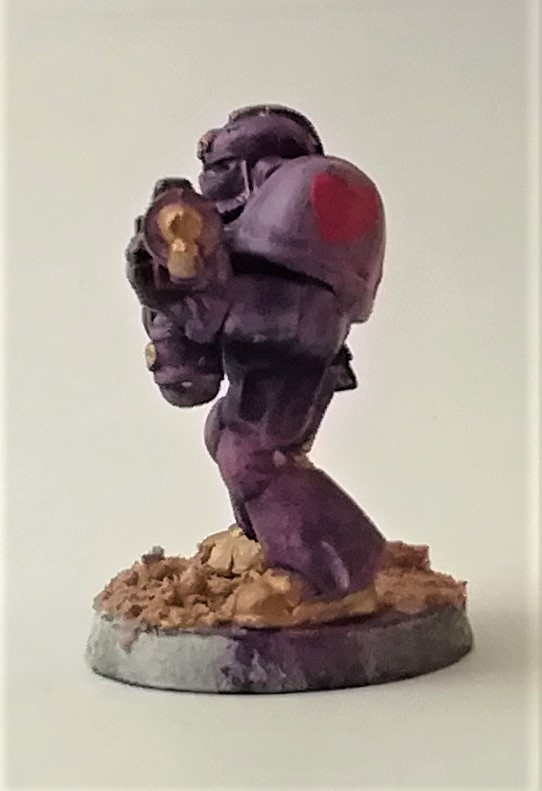
The "Love marine", which was an old single GW plastic miniature that belonged to R:


The farmer and his wife (Prismatic Void Commoners)...


and... Ah, right! Their spotted horse and hitch (Wizkids):


 Apart from the Marine, the others will be part of the Black Fire Pass diorama.
    Moreover, I based the gor with moss and a skull and submitted it to a painting contest, run by the shop where I take the class:


It looks nice in the under 16 category!


___________________________________________________________________


Ecco le nuove miniature che ho dipinto!
Il "Love marine", che era una vecchia miniatura singola di plastica GW che apparteneva a R:


Il contadino e sua moglie (Prismatic Void Commoners)...


...e...Ah,giusto! Il loro cavallo a macchie e la loro staccionata (Wizkids):


A parte il Marine, gli altri faranno parte del diorama del Passo della Fiamma Nera.
    Ho poi imbasettato il gor con muschio e un teschio e l'ho presentato a un concorso di pittura, organizzato dal negozio in cui faccio il corso:


Fa una bella figura nella categoria under 16!


domenica 25 dicembre 2022

R&D: MERRY BEASTMAS AGAIN! / DI NUOVO NATALE ABBESTIA!

     The end of the year is, as is tradition, time for a quick assessment. Although in the last twelve months we have not obtained a particularly fruitful harvest in terms of painted miniatures, our attention towards this hobby has not diminished, but rather structured.    
    First of all, despite some breaks, our blog has survived and it doesn't seem like a trivial matter these days. We have also managed to follow with interest the activity of other intrepid bloggers, with whom we share a passion for miniatures, be they fantasy or historical.
    We have begun to attend some fairs or painting competitions as visitors (Hellana in April and Monte San Savino Show in November), coming into direct contact with other enthusiasts.
    We have also broadened our fantasy horizons by entering other worlds such as that of Terry Pratchett's Discworld, of which we have read "The Colour of Magic" together and are currently reading "Equal Rites".
    If with the painting work of the Napoleonic soldiers entrusted to us we were almost left at a standstill, at least the inconclusive R deepened his knowledge of the Alternative Armies gnolls, and  poured his conclusions into the Lost Minis Wiki database, deluding himself that he is finally accomplishing something.
    D has instead commendably started attending a painting class in the autumn which scored a few points, increasing the total number of painted miniatures! Among them D also painted the first miniature of the warband of gors for her diorama of Black Fire Pass - having completed in an hour the miniature that R had spent a week filing, washing, assembling and pinning. But you know, our working times are poles apart...
    Wishing everyone a new year of peaceful continuation of their hobby passions, we can finally show the ferocious gor:


Gor
And my herd? I've been looking for it for a year!


    As a Christmas card, we conclude with a photo of a medieval relief that we observed during our summer holidays in southern Italy: confirming that Warhammer didn't create anything!


Cathedral of Trani (Apulia), detail of the portal, 12th century

___________________________________________________________ 


    Il termine dell'anno è, come di tradizione, tempo di un rapido bilancio. Sebbene in questi ultimi dodici mesi non abbiamo ottenuto un raccolto particolarmente fruttuoso in termini di  miniature dipinte, la nostra attenzione verso questo hobby non è  diminuita, ma si è anzi strutturata.
    Innanzitutto, nonostante qualche pausa, il nostro blog è sopravvissuto e non ci sembra di questi tempi cosa da poco. Siamo anche riusciti anche a seguire con interesse l'attività di altri impavidi bloggers, con cui condividiamo la passione per le miniature, siano esse fantasy o storiche.
   Abbiamo anche cominciato a frequentare come visitatori qualche fiera o competizione di pittura (Hellana in aprile e Monte San Savino Show in novembre), entrando in contatto dal vivo con altri appassionati.
    Abbiamo inoltre ampliato i nostri orizzonti fantasy entrando in altri mondi come quello del Mondo Disco di Terry Pratchett, di cui abbiamo letto insieme "Il colore della magia" e stiamo attualmente leggendo "L'arte della magia".
    Se con il lavoro di pittura dei soldatini napoleonici che ci sono stati affidati siamo rimasti quasi al palo, almeno l'inconcludente R ha approfondito la conoscenza dei suoi gnolls Alternative Armies, e per lo meno ha riversato le sue conclusioni nel database Lost Minis Wiki, illudendosi di portare finalmente a compimento qualcosa.
    D ha invece meritoriamente cominciato a frequentare dall'autunno un corso di pittura che ha segnato qualche punto, incrementando il totale delle miniature dipinte! Tra esse D ha anche dipinto la prima miniatura della banda di gors per il suo diorama del Passo della Fiamma Nera - avendo completato in un'ora la miniatura che R aveva impiegato una settimana a limare, lavare, montare e incollare con i perni. Ma si sa, i nostri tempi di lavoro sono agli antipodi...
    Augurando a tutti un nuovo anno di serena prosecuzione delle proprie passioni hobbistiche, possiamo finalmente mostrare il feroce gor:


E il mio branco? Lo sto cercando da un anno! 


    Come cartolina natalizia, concludiamo con la foto di un bassorilievo medievale che abbiamo osservato durante le nostre vacanze estive nell'Italia meridionale: a conferma che Warhammer non ha inventato nulla!


Cattedrale di Trani (Puglia), dettaglio del portale, XII secolo


domenica 26 dicembre 2021

R&D: MERRY BEASTMAS! / NATALE ABBESTIA!


Greetings,
    We are writing this post to show you how generous Father Beastman was in bringing to both of us, R and D, reinforcements for our projects.
A very gigantic Citadel minotaur in metal, already primed, has come down the chimney to help D's warband of gors in their evil intent.


Citadel_Minotaur


    Felix and Gotrek will be surprised to find such a beast!


Minotaur bestigor Felix Gotrek


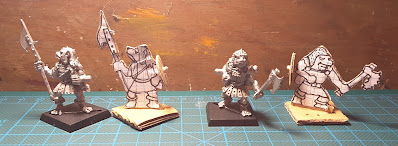
    R has been very good this year, as he received two ADD55 gnolls that his pack of Nuthgnawers lacked: a third gnoll of five with the pole weapon, and the fourth and last gnoll with the axe. Here they are next to their cardboard templates, which can now be used to light the fire in the fireplace.


ADD55 gnolls


    And finally, here is a family photo of all the Nuthgnawers gathered so far. Only two ADD55 with pole weapons are missing, while the giant zombie wolf is not present because it is preparing the Christmas lunch (better not to know what ingredients it will use!).


Nuthgnawers


Happy holidays and bestial fun for everyone!

__________________________________________________________________________


Salve,
    scriviamo questo post per farvi vedere quanto è stato generoso Babbo Bestia nel portare ad entrambi noi, R e D, dei rinforzi per i nostri progetti.
    A D è sceso dal camino un minotauro Citadel assai gigantesco in metallo, già primerato, che aiuterà la banda di gors nel loro malefico intento.


Citadel Minotaur


    Felix e Gotrek saranno sorpresi di trovarsi davanti un bestione del genere!


Minotaur bestigor Felix Gotrek


    R è stato molto buono quest’anno, visto che ha ricevuto ben due gnolls ADD55 che mancavano alla sua banda di Nuthgnawers: un terzo gnoll di cinque con l’arma in asta e il quarto ed ultimo gnoll con l’ascia. Eccoli accanto ai loro modelli di cartone, che potranno ora essere usati per accendere il fuoco nel camino.


Gnolls ADD55


    Ed ecco infine una foto di famiglia di tutti i Nuthgnawers finora radunati. Mancano solo due ADD55 con armi in asta, mentre il lupo zombie gigante non è presente perché sta preparando il pranzo di Natale (meglio non sapere con quali ingredienti!).


Nuthgnawers warband


    Buone feste e un divertimento bestiale a tutti!

domenica 19 dicembre 2021

R: WHEN SIZE MATTERS: 28 MM "HEROIC SCALE" FOR HUMANS, GNOLLS AND DOGMEN / QUANDO LE DIMENSIONI CONTANO: "SCALA EROICA" DI 28 MM PER UMANI, GNOLL E UOMINI CANE

 THE SCALE OF CITADEL GNOLLS AND ALTERNATIVE ARMIES DOGMEN


    To credibly create my "mosaic" full of scenic elements I have to take careful consideration of the scale of the miniatures that make up the pack of the Nuthgnawers. I found a useful guide in the systematic treatment of the subject by Kadmon of Alkony Workshop, to whom reference for the technical terms used below.

    The gnoll/dogman miniatures I use belong to the period between the mid-1980s (precisely 1985 for Citadel ADD55 and BDD2) and the very early 1990s (1991 and 1993 for Alternative Armies OH6 and OH16, as Gavin Syme kindly pointed out to me). The 28 mm scale at eye level was already becoming predominant, and one might think that they were all designed for that scale. In fact, the Alternative Armies website indicates 25/28 mm for its miniatures, although it will be seen that the dimensions are significantly different between the two sets. Within the regiment, the giant zombie wolf of Rackham is an exception, because it has a different scale and dates back to a more recent period (early 2000s), and we will leave it aside for the moment.

    Although it is a unit made up of bestial creatures, since in my setting the gnolls/dogmen will attack a settlement of the Empire, I could not help but take as a reference height that of human beings of 28 mm; and after all, the absolute scale of 28 mm at eye level refers precisely and first of all to human beings of normal height.

Gnoll raiding party
Gnoll raiding party (illustration by  Stephen Crowe in "Dragon" 367)

    Considering fantasy miniatures instead of historical ones, however, involves another caution: that of dealing with the "heroic scale", where, as is well known, the proportions of the body are not fully respected, but in which some parts are oversized, like the head, the limbs and even the weapons or tools. And the miniatures of my regiment are also subject to this deformation.

    But how tall are gnolls in the "reality" of the Advanced Dungeons & Dragons fictional universe that created them? And what is the stature of AA's dogmen?

THE DIMENSIONS OF AD&D GNOLLS (AND DOG MEN)


    Leaving aside now how the old "gnoles" are described or illustrated in Lord Dunsany's or St. Clair's stories, or even by Gygax in the early days of Dungeons & Dragons (see my previous post), starting with when the gnolls took over the aspect of anthropomorphic hyenas in the late seventies their stature was indicated as being superior to that of humans. As the AD&D "Monster Manual" (p. 46) expresses, the height is set at "7 (feet) + tall", equal to cm 213.3 + [I would like to remind all those who have taken the bad habit of using the decimal system and who persist in playing games created in an Anglo-Saxon environment with the following equivalences: 1 foot = 30.48 cm; 1 inch = 2.54 cm]. In the "Monstrous Compendium" vol. 1 (1989) the dimensions are specified at "7 ½ 'tall", which brings these creatures to a good 228.6 cm and which is maintained even later in indicating the interval " 7' 0 '' - 7 '6'' " (e.g. in the article K. Baker, "Playing gnolls" in "Dragon " 367, p. 56). It will be useful to remember that, although there were no indications of this feature in the first manual, subsequently the gnolls were imagined lean and not very muscular in the updates of AD&D.

Pathfinder RPG gnolls
Firebrand Opener (illustration by Tomasz Chistowski 
in John Compton et al., "Lost Omens Character Guide", 2019, pp. 66-67)

     There is very little information for the Alternative Armies dogmen. Beyond the suspicion that they were originally inspired by the gnolls of AD&D, in the few lines dedicated to them on the AA website there is no mention of an abnormal stature compared to the human one, but rather of their belonging to the species "canum cobalorum". In a very imprecise Latin declination, the noun "canis" is combined with "cobalus", which is the Latin word for the sprite from which the goblin would later derive; in fact, an explicit morphological affinity is established between dogmen and goblins, although the former are larger.

MINIATURE HUMAN BEINGS AND GNOLLS /DOGMEN ...


    Also on the side of rendering these creatures into miniatures, many gnolls with dog/hyena features made over time by various manufacturers have very different sizes, often larger than the stature of a human miniature, as you can see from the two photos below, which I draw from a Lead Adventure Forum topic.


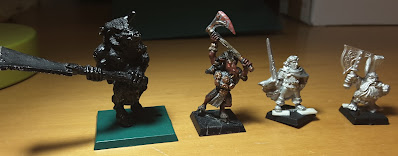
    Thinking of doing something useful, I decided to show a shot of the gnoll/dogman miniatures in my possession, which are not very common and do not appear in any miniature size comparison. They are placed next to the miniature of a human being, against the background of a squared sheet with 5 mm squares. I took it as "ideal man" miniature Felix Jaeger of the couple Felix and Gotrek 1993 ... OKAY, I am obliged to point out that D is keen to stress, as every time I touch the miniature of Felix, that it is HERS, and she needs it for HER project!

Felix Nuthgnawers

    Left to right: AA OH6 dogman 25 mm at the eyes, 28 mm at the top of the head; Felix, the eyes 28 mm, 30 mm at the top of the head; Citadel ADD55 gnoll, 30mm at the eyes, 35mm at the top of the head; AA OH16 dogman, 28 mm at the eyes, 30 mm at the top of the head. Note, however, that the dogmen in both Alternative Armies sets have a slightly curved back and their heads sunken between their shoulders. The Citadel gnoll with the axe represents the largest type of the ADD55 variants, while the others armed with bows or pole weapons stand at 31-32 mm at the top of the head. Finally, the single gnoll of the Monster Box set (BDD2), although less massive, is 33 mm high.

...AND "REAL" HUMAN BEINGS AND GNOLLS/DOGMEN


    I know that for an absolute scale of 28mm it is improper to try to derive a ratio with real dimensions, but I can't stop myself from doing this experiment. As mentioned above, we do not know the exact scale at which the miniatures of the various manufacturers were originally designed; however it will be necessary to assume a unit scale of 28 mm here, as they will be united in a playable regiment for WHFB. The reference point is, as we have said, a human of 30 mm at the top of the head. We can assume that a human warrior is 6 feet tall, equal to 183 cm (182.88 cm to be precise): not very likely for the average height of medieval man, but in line with Tolkien's classic fantasy. Consequently 1 cm of the miniature corresponds to 2 feet = 61 cm.

    On this basis, the gnoll/dogman miniatures would turn out to be the following dimensions:

- dogman AA OH6 (28 mm): 170.8 cm;

- dogman AA OH16 (30 mm): 183 cm;

- gnoll ADD55 (35 mm): 213.5 cm; (32 mm): 195.2 cm; (31 mm): 189.1 cm;

- gnoll BDD2 (33 mm): 201.3 cm.


    The conclusion is that, even neglecting the shorter than a human dogmen AA OH6, all the gnolls/dogmen appear less tall than the gnolls proposed by AD&D: just keep in mind that the most imposing gnoll, the one with the axe photographed above, is just 7 feet, the minimum size of the gnoll that the AD&D manuals indicate! This is not a problem however, as my miniatures, as mentioned several times, will be a variety of beastmen in the Warhammer world, not necessarily reaching as tall as 7' AD&D gnolls. At the same time, what is lost in height is compensated for by the massive build of these creatures, including even those less tall, which are all bulkier than the human body.

    For the purposes of making the scenic bases for my gnoll/dogman regiment of Nuthgnawers, I will therefore need to keep in mind that gnoll miniatures tend to be taller and beefier than a human miniature. This will have to be considered when I insert human elements in the bases, which necessarily have to appear proportionate compared to a human miniature, but undersized compared to my dogmen when they are scattered between a graveyard of men and the house in front of it ...


UPDATE (30/12/2021)


    I have lately had confirmation that the ADD human miniatures produced between 1985 and 1987 by Citadel had a scale of 28mm, BUT FROM THE TOP OF THE HEAD (25mm at eye level). This changes the proportions between the miniatures and the real dimensions that can be obtained, indicating that within the ADD range Citadel had expected a fairly faithful respect of the disproportion between men and gnolls.
    Maintaining the standard human height of 183 cm, 1 cm thus equated to 65.4 cm. Consequently, the actual height of the Citadel gnolls was also different, and more closely matched the height range indicated by Advanced Dungeons & Dragons:
gnoll 35 mm = 228.9 cm;
gnoll 33 mm = 215.82 cm;
gnoll 32 mm = 209.28 cm;
gnoll 31 mm = 202.74 cm.
    These considerations will not change my approach, however, as I confirm that the humans I intend to use as standard for Warhammer will instead be 30mm tall (like Felix) at the top of the head, and therefore there will be less disproportion compared to gnolls /dogmen.

___________________________________________________________________________


LA SCALA DEGLI GNOLL CITADEL E DEGLI UOMINI CANE ALTERNATIVE ARMIES


    Per realizzare in modo credibile il mio “mosaico” ricco di elementi scenici devo prendere in attenta considerazione alla scala delle miniature che compongono il branco dei Nuthgnawers: ho trovato un’utile guida nella trattazione sistematica dell’argomento da parte di Kadmon di Alkony Workshop, al quale rinvio per i termini tecnici usati di seguito.

    Le miniature di gnoll/uomini cane che uso appartengono al periodo tra la metà degli anni Ottanta (precisamente 1985 per Citadel ADD55 e BDD2) e i primissimi anni Novanta (1991 e 1993 per OH6 e OH16 di Alternative Armies, come Gavin Syme mi ha cortesemente precisato). La scala di 28 mm all’altezza degli occhi stava già diventando predominante, e si potrebbe pensare che siano tutte state concepite per quella scala. In realtà il sito di Alternative Armies parla di 25/28 mm per le sue miniature, anche se si vedrà che le dimensioni sono sensibilmente diverse tra i due set. All’interno del reggimento fa eccezione il lupo zombie gigante di Rackham, che ha una scala diversa e risale ad un periodo più recente (primi anni Duemila) e che per il momento lasceremo da parte.

    Sebbene si tratti di un’unità formata da creature bestiali, visto che nella mia ambientazione gli gnoll/uomini cane assalteranno un insediamento dell’Impero, non ho potuto fare a meno di assumere come statura di riferimento quella di esseri umani di 28 mm; e del resto la scala assoluta di 28 mm all’altezza degli occhi si riferisce appunto e prima di tutto ad esseri umani di altezza normale.


Squadra di razziatori gnoll (illustrazione di Stephen Crowe in "Dragon" 367)

    Il considerare miniature fantasy invece che storiche comporta però un’altra accortezza: quella di avere a che fare con la “scala eroica”, dove, com’è noto, infatti, non sono rispettate appieno le proporzioni del corpo, ma in cui alcune parti sono sovradimensionate, come la testa, gli arti ed anche le armi o gli utensili impugnati. E a questa deformazione sono soggette anche le miniature del mio reggimento.

    Ma quanto sono alti gli gnoll nella “realtà” dell’universo immaginario di Advanced Dungeons & Dragons che li ha creati? E qual è la statura degli uomini cane di AA?

LE DIMENSIONI DEGLI GNOLL DI AD&D (E DEGLI UOMINI CANE)


    Lasciando ora da parte come i vecchi “gnoli” sono descritti o illustrati nei racconti di Lord Dunsany o di St. Clair, o anche da Gygax agli albori di Dungeons&Dragons (vedi il mio post precedente), a partire da quando gli gnoll hanno assunto l’aspetto di iene antropomorfe nei tardi anni Settanta la loro statura è stata indicata come superiore a quella umana. Come si esprime il “Manuale dei mostri” di AD&D (p. 46), l’altezza è stabilita a “7 (piedi)+ tall”, pari a cm 213,3 + [mi permetto di ricordare a tutti coloro che hanno preso la cattiva abitudine di usare il sistema decimale e che si ostinano a giocare a giochi creati in ambiente anglosassone le seguenti equivalenze: 1 piede = cm 30,48; 1 pollice = cm 2,54]. Nel “Monstrous Compendium” vol. 1 (1989) le dimensioni si precisano a “7 ½’ tall”, che porta queste creature a ben cm 228,6 e che si mantiene anche successivamente nell’indicare l’intervallo “ 7’ 0’’-7’ 6’’ " (ad es. nell’articolo K. Baker, “Playing gnolls” in “Dragon” 367, p. 56). Tornerà utile ricordare che, sebbene non vi fossero indicazioni in tal senso nel primo manuale, successivamente gli gnolls sono stati immaginati magri e non molto muscolosi negli aggiornamenti di AD&D.

Pathfinder RPG gnolls
Firebrand Opener (illustrazione di Tomasz Chistowski 
in John Compton et al., "Lost Omens Character Guide", 2019, pp. 66-67)


    Per gli uomini cane di Alternative Armies vi sono pochissime informazioni. Al di là del sospetto che siano stati originariamente ispirati dagli gnoll di AD&D, nelle poche righe ad essi dedicate sul sito di AA non si parla di una statura abnorme rispetto a quella umana, bensì di una loro appartenenza alla specie “canum cobalorum”. Pur nella declinazione latina molto approssimativa, sono abbinati il sostantivo “canis” a “cobalus”, che è la parola latina per lo spiritello da cui sarebbe poi derivato il goblin; infatti viene istituita un’esplicita affinità morfologica tra uomini cane e goblin, sebbene i primi siano più grandi.

ESSERI UMANI E GNOLL/UOMINI CANE IN MINIATURA…


    Anche sul versante della traduzione di queste creature in miniature, molti gnoll con fattezze di cane/iena realizzate nel tempo da diversi produttori hanno dimensioni assai diverse, spesso maggiori rispetto alla statura di una miniatura umana, come si può vedere dalle due foto qui sotto, che traggo da un topic di Lead Adventure Forum


    Pensando di fare cosa utile, ho deciso di mostrare una foto delle miniature di gnoll/uomini cane in mio possesso, che sono poco diffusi e non figurano in nessun confronto tra dimensioni di miniature. Esse sono messe accanto alla miniatura di un essere umano, sullo sfondo di un foglio quadrettato con quadretti di 5 mm. Ho preso come “uomo ideale” la miniatura di Felix Jaeger della coppia Felix e Gotrek del 1993… VA BENE, sono obbligato a precisare che D tiene a sottolineare, come ogni volta che tocco la miniatura di Felix, che è SUA e che serve per il SUO progetto!

Felix e Nuthgnawers

    Da sinistra a destra: uomo cane AA OH6 25 mm agli occhi, 28 mm alla sommità della testa; Felix, 28 mm agli occhi, 30 mm alla sommità della testa; gnoll Citadel ADD55, 30 mm agli occhi, 35 mm alla sommità della testa; uomo cane AA OH16, 28 mm agli occhi, 30 mm alla sommità della testa. Da notare tuttavia che gli gnoll di entrambi i set Alternative Armies hanno una schiena leggermente curva e la testa incassata tra le spalle. Lo gnoll Citadel con l’ascia rappresenta il tipo più grosso delle varianti di ADD55, mentre gli altri armati di arco o armi in asta si attestano sui 31-32 mm alla sommità della testa. Infine il singolo gnoll del Monster Box set (BDD2), sebbene meno massiccio, è alto 33 mm.

….ED ESSERI UMANI E GNOLL/UOMINI CANE “REALI”


    So che per una scala assoluta di 28 mm è improprio tentare di ricavare un rapporto con dimensioni reali, ma non riesco a trattenermi dal fare questo esperimento. Come detto sopra, non conosciamo l’esatta scala alla quale furono originariamente ideate le miniature dei diversi produttori; tuttavia si dorvà qui assumere una scala unitaria di 28 mm, visto che saranno uniti in un reggimento giocabile per WHFB. Il punto di riferimento è, come si è detto un umano di 30 mm alla sommità della testa. Possiamo presupporre che un guerriero umano sia alto 6 piedi, pari a cm 183 (per la precisione cm 182,88): non molto verisimile per la statura media dell’uomo medievale, ma in linea con il fantasy classico di Tolkien. Di conseguenza 1 cm della miniatura corrisponde a 2 piedi = cm 61.

    Su questa base, le miniature di gnoll/uomini cane risulterebbero avere le seguenti dimensioni:

- uomo cane AA OH6 (mm 28): cm 170,8;

- uomo cane AA OH16 (mm 30): cm 183;

- gnoll ADD55 (mm 35): cm 213,5; (mm 32): cm 195,2; (mm 31): cm 189,1;

- gnoll BDD2 (mm 33): cm 201,3.


    La conclusione è che, anche trascurando gli uomini cane AA OH6 più bassi di un uomo, tutti gli gnoll/uomini cane appaiono meno alti rispetto agli gnoll proposti da AD&D: basti tener presente che lo gnoll più imponente, quello con l’ascia fotografato sopra, è appena 7 piedi, la misura minima dello gnoll che i manuali di AD&D indicano! Questo non è tuttavia un problema, perché le mie miniature, come già detto più volte, saranno una varietà di uomini bestia nel mondo di Warhammer, che non raggiungono necessariamente stature così alte come gli gnoll di 7 piedi di AD&D. Contemporaneamente, ciò che viene perduto in altezza viene compensato dalla corporatura massiccia di queste creature, comprese anche quelle meno alte, che figurano tutte più grosse del corpo umano.

    Ai fini della realizzazione dello scenario delle basi del mio reggimento gnoll/uomini cane, dovrò quindi tenere presente che le miniature degli gnoll/uomini cane sono tendenzialmente più alte e nerborute della miniatura di un uomo. Questo andrà considerato quando inserirò elementi umani nelle basi, che necessariamente dovranno apparire proporzionati rispetto ad una miniatura umana, ma sottodimensionati rispetto ai miei uomini cane quando essi si sparpaglieranno tra un cimitero di uomini e la casa di fronte ad esso…  


AGGIORNAMENTO (30/12/2021)


    Ho avuto ultimamente conferma che le miniature umane ADD prodotte tra 1985 1987 da Citadel avevano una scala di 28 mm, MA DALLA SOMMITÀ  DELLA TESTA (25 mm all'altezza degli occhi). Ciò modifica le proporzioni tra le miniature e le dimensioni reali ricavabili, indicando che all'interno della gamma ADD Citadel aveva previsto un rispetto abbastanza fedele della sproporzione tra  uomini e gnoll.
    Mantenendo l'altezza umana standard di 183 cm, 1 cm equivaleva così a 65,4 cm. Di conseguenza anche l'altezza reale degli gnoll Citadel era differente, e corrispondeva maggiormente all'intervallo della statura indicata da Advanced Dungeons&Dragons:
gnoll 35 mm = cm 228,9;
gnoll 33 mm = cm 215,82;
gnoll 32 mm = cm 209,28;
gnoll 31 mm = cm 202,74.
    Queste considerazioni non modificheranno comunque la mia impostazione, perché confermo che gli umani che intendo utilizzare come standard per Warhammer saranno invece alti (come Felix) 30 mm alla sommità della testa, e ci sarà quindi meno sproporzione in confronto agli gnoll/uomini cane.

domenica 7 novembre 2021

R: THE TECHNIQUE OF MOSAIC, IN LEAD AND WORDS /LA TECNICA DEL MOSAICO, IN PIOMBO E PAROLE

    I would like to immediately reassure the readers of this blog, perhaps alarmed by the title: I have not decided to change my hobby and devote myself to art - also because I do not know if I would be able to make the figure of a gnoll with the mosaic, nor do I know of anyone who ever has tried it.
The word "mosaic" is what I found to define how I set out to realize my project of the regiment of dogmen, both in the arrangement of the miniatures and in the narration that accompanies them. This post is intended to clarify what I mean and how I want to carry out the work.

A MOSAIC OF MINIATURES


    Although I have never been a WHFB (or, more recently, T9A) player, in starting my regiment I would like to keep the setup of a unit that I may perhaps be able to play with in the future. At the same time, I would like to create a setting for the warband that places the miniatures in a unitary and easily understandable context. At this point, surfing the web and watching the results of other hobbyists live, some options were presented to me, which I summarize in the strengths and weaknesses of each, with a very subjective selection of images.

A) Classic diorama


Pros: freedom to place miniatures and scenery in the most realistic way in space.
Cons: conceived for display only, the miniatures are fixed to the setting.


(John Blanche's epic diorama of Undead assault to a dwarven stronghold, from Realm of Chaos 80s)


B) Diorama with removable miniatures


Pros: same as above, but miniatures can be removed and used for the game.
Cons: almost all the richness of the original scenario is lost when the miniatures are placed on the game table.


(Gotrek and Felix diorama by Benathai, from Chest of  Colors)

C) Movement tray with spaced miniatures


Pros: the entire tray is placed on the game table, the miniatures are removable and more visible individually, the space in between can be used to insert scenic elements.
Cons: for game purposes it can only be used for skirmish units, not regular units.


(Archer skirmish unit by Johan Mars, from The Blood of Kittens)

D) Regiment with unit filler


Pros: perfectly playable and the unit filler allows you to create a mini diorama inside the regiment.
Cons: often (but not always) there are disparities in the richness of the setting of the unit filler compared to the individual bases of the rest of the soldiers in the regiment. Several miniatures can be placed in the unit filler, which however lose their individuality, or only scenic elements that are not miniatures can be inserted.


(Grundel's defenders by Dave Taylor, from Dave Taylor Miniatures)

    For my project I thought of an arrangement that I believe is original and that combines many advantages of the previous options. In the "mosaic" each miniature will have its own 25x25 mm base, but in each of them there will be a scenic element which, juxtaposed with the others on the nearby bases, will help create a rich and uniform setting. I will also use a 50x50 mm unit filler, where I will have more space to insert scenic elements, but which will still remain the base of a single miniature.
I do not deny that even the "mosaic" could have some downsides:

  • it is an unnatural arrangement, because the miniatures are uniformly tightened, without leaving the spaces that normally form when encountering obstacles.
  • the insertion of scenic elements on such small bases risks suffocating the miniatures, making them stand out little in the compositional balance.
  • the elements to be placed on a 25x25 mm base without protruding must not be too large and cumbersome.
  • assigns the miniatures a specific place within the unit, which cannot be changed without affecting the legibility of the scene from an aesthetic point of view.

    It will basically be a challenge, looking for a balance between each miniature and its scenic base; and a balance in the juxtaposition of each base to the other, to form a sort of diorama composed of the sum of many tiles, just like a mosaic.
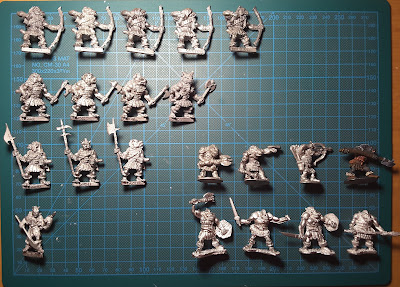
    In order not to leave the post without images that are not related to other people's miniatures, I propose an updated version of my regiment, still in the preliminary phase, but with the addition of the tenth archer gnoll that I showed in the previous post (second row, on the right), of a standard template and the legs of the zombie wolf in its place (in the last row on the left).


Nuthgnawers


A MOSAIC OF STORIES


    Parallel to the painting of miniatures, I planned to give personality to each member of the warband by assigning him not only a name, but also a short narration that illustrates his history, his character, his motivations. This is by no means new and the precedents are very numerous.
    My "mosaic" differs, if anything, by the fact that each miniature will have a real short story to accompany it, also inspired by the scenic elements of its base, not without a touch of the humor that characterized Warhammer in the '80s. Furthermore, every single story will be added to the stories of the nearby miniatures, with the contradictions and twists that human (or bestial, in this case) relationships bring with them; gradually they will unite in a broader narrative, the full meaning of which will be grasped only when the last miniature is painted and the last story is written!

    Is this too ambitious or unnecessarily too complicated a project? Well, at least that helps to explain why I didn't go head-on into painting the miniatures...
Critique and comment are welcome!

__________________________________________________________________________


    Vorrei tranquillizzare subito i lettori di questo blog, forse allarmati dal titolo: non ho deciso di cambiare hobby e dedicarmi all’arte – anche perché non so quanto mi riuscirebbe realizzare la figura di uno gnoll a mosaico, né so di qualcuno che ci abbia mai ancora provato.
    La parola “mosaico” è quella che ho trovato per definire il modo in cui mi sono riproposto di realizzare il mio progetto del reggimento di uomini cane, sia nella disposizione delle miniature, sia nella narrazione che le accompagni. Questo post ha lo scopo di chiarire che cosa voglio dire e come voglio proseguire il lavoro.

UN MOSAICO DI MINIATURE


    Sebbene non sia mai stato un giocatore di WHFB (o, più recentemente, di T9A), nel dar vita al mio reggimento vorrei mantenere l’impostazione di un’unità con cui forse potrò giocare in futuro. Contemporaneamente vorrei creare per la banda un’ambientazione che inserisca le miniature in un contesto unitario e ben comprensibile. A questo punto, navigando sul web e guardando dal vivo i risultati di altri hobbisti, mi si sono presentate alcune soluzioni, che riepilogo nei punti forti e nelle debolezze di ciascuna, aggiungendo una selezione molto soggettiva di immagini.

A) Diorama classico


Pro: libertà di collocare le miniature e gli elementi scenici nel modo più realistico nello spazio.
Contro: concepito solo per esposizione, le miniature sono fissate all'ambientazione.


(L'epico diorama di John Blanche dell'assalto dei non morti a una fortezza nanica, da  Realm of Chaos 80s)

B) Diorama con miniature rimovibili


Pro: come sopra, ma le miniature possono essere rimosse ed utilizzate per il gioco.
Contro: quasi tutta la ricchezza dello scenario originario si perde quando le miniature sono messe sul tavolo da gioco.


(Diorama di Felix e Gotrek di Benathai, da Chest of Colors)

C) Vassoio di movimento con miniature distanziate


Pro: l'intero vassoio viene disposto sul tavolo di gioco, le miniature sono rimovibili e più visibili singolarmente, lo spazio intermedio può essere sfruttato per inserire elementi scenici.
Contro: ai fini del gioco è utilizzabile solo per unità di schermagliatori, non per unità regolari.


(Unità di arcieri schermagliatori di Johan Mars, da The Blood of Kittens)

D) Reggimento con unit filler


Pro: perfettamente giocabile e lo unit filler permette di creare un mini diorama all'interno dell'unità.
Contro: spesso (ma non sempre) vi sono disparità nella ricchezza di ambientazione dello unit filler rispetto alle singole basi del resto dei soldati dell'unità. Nello unit filler posso essere collocate più miniature, che però perdono così la loro individualità, o possono essere inseriti soltanto elementi scenici che non sono miniature.


(Grundel's defenders di Dave Taylor, da Dave Taylor Miniatures)

    Per il mio progetto ho pensato a una disposizione che credo originale e che unisca molti vantaggi delle soluzioni precedenti. Nel "mosaico" ogni miniatura conserverà cioè una propria base di 25x25 mm, ma in ciascuna di esse vi sarà un elemento scenico che, giustapposto agli altri sulle basi vicine, contribuirà a creare un’ambientazione ricca ed uniforme. Userò poi anche uno unit filler di 50x50 mm, dove avrò più spazio per inserire elementi scenici, ma che comunque resterà la base di una singola miniatura.

Non nascondo che anche il "mosaico" potrebbe avere alcuni lati negativi: 

  • è una disposizione innaturale, perché le miniature sono uniformemente serrate, senza lasciare gli spazi che normalmente si formano quando si incontrano ostacoli. 
  • l’inserzione di elementi scenici su basi così piccole rischia di soffocare le miniature, facendole risaltare poco nell’equilibrio compositivo. 
  • gli elementi da porre su una base di 25x25 mm senza debordare non dovranno essere troppo grandi ed ingombranti. 
  • assegna alle miniature un posto preciso all’interno dell’unità, che non può essere modificato senza pregiudicare la leggibilità della scena dal punto di vista estetico.

    Si tratterà in buona sostanza di una sfida, alla ricerca di un equilibrio tra ogni miniatura e la sua base scenica; e di un equilibrio nell’accostamento di ogni base all’altra, per formare una sorta di diorama composto dalla somma di tante tessere, come appunto un mosaico.

    Per non lasciare il post privo di immagini che non siano relative a miniature altrui, ripropongo una versione aggiornata del mio reggimento, ancora in fase preliminare, ma con l’aggiunta del decimo gnoll arciere che ho mostrato nel post precedente (seconda fila, a destra), di un modello di stendardo e della parte inferiore del lupo zombie al suo posto (in fondo a sinistra). 

Nuthgnawers


UN MOSAICO DI STORIE


    Parallelamente alla pittura delle miniature, ho progettato di dare personalità a ogni membro della banda assegnandogli non solo un nome, ma anche una breve narrazione che illustri la sua storia, il suo carattere, le sue motivazioni. Questa non è affatto una novità e i precedenti sono numerosissimi.
    Il mio “mosaico” si differenzia semmai per il fatto che ogni miniatura avrà una vera e propria short story che la accompagni, ispirata anche agli elementi scenici della sua base, non senza una spruzzata dello humor che contraddistingueva Warhammer negli anni Ottanta. Ogni singola storia si sommerà per di più alle storie delle miniature vicine, con le contraddizioni e i colpi di scena che i rapporti umani (o bestiali, in questo caso) portano con sé; gradualmente esse si uniranno in una narrazione più ampia, il cui senso pieno si coglierà solo quando l’ultima miniatura sarà dipinta e l’ultima storia sarà scritta!

    Un progetto troppo ambizioso o inutilmente troppo complicato? Beh, almeno questo contribuisce a spiegare perché non mi sono buttato a testa bassa nel dipingere direttamente le miniature…
Commenti e critiche sono i benvenuti!

R: GNOLL GOSSIP: AA OH6 DOGMEN AGAIN /GOSSIP GNOLL: ANCORA UOMINI CANE AA OH6

    Unfortunately February was a less than productive month for the hobby, but I am able to present some further information on the dogmen o...